
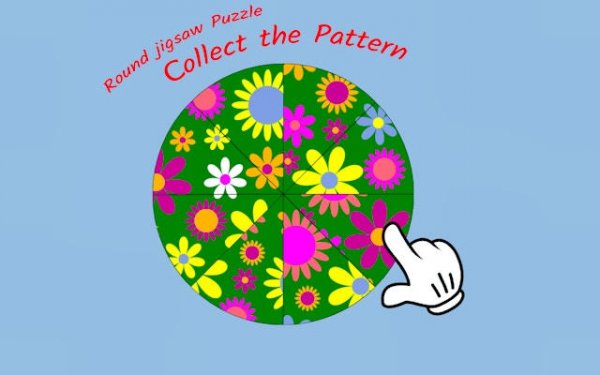
Round Mosaic Tile Swap
Opens in a play window — no download required.
Reviews
Round Mosaic Tile Swap stands out for what it removes: no drag-and-drop, no rotation, no timers. The circular board and angled edges make each swap a genuine decision, and visual clues reward careful observation. It suits players who prefer methodical solving over reflex challenges. The main limitation is that the game offers no stated variation beyond tile count, so its appeal depends on how much you enjoy refining your own completion time.
Description
Circular Board, Angled Edges
Most tile puzzles use a square grid. Round Mosaic Tile Swap arranges triangular sections in a circle, so every piece meets its neighbors along angled edges. That geometry changes how you read the board: a tile that looks correct on one side can be wrong on another, because the curve forces you to judge both shape and orientation before you commit to a position.
Swap, Don't Drag
The only action is selecting two tiles and exchanging their spots. There is no drag-and-drop, no rotation, and no partial move. Each swap happens instantly, which makes experimentation cheap but planning valuable. The real challenge is sequencing: a swap that fixes one tile can displace another, so efficient solvers think a few moves ahead rather than reacting to the board.
Reading the Image
Every tile carries a fragment of the larger picture. Colors, lines, and patterns are your map. Distinct borders and unusual color blends are the easiest anchors, because they narrow down where a piece can possibly belong. Players who study those cues before swapping tend to guess less and solve faster than players who move tiles on impulse.
Puzzle Variety and Pacing
Puzzles can vary in tile count, and more pieces mean more time and more thought per image. Completion time is tracked, so repeated attempts give you a way to measure improvement. Nothing punishes a wrong move: there are no timers and no penalties, so you can examine the board as long as you like. That makes the game comfortable for a short break or a longer, focused session.
Compatibility
FAQ
Comments
Sign in to leave a note
You must be logged in before posting a review or rating.
No comments yet. Be the first to comment!





Editorial Notes