
Grid Snake: Spatial Reasoning
Opens in a play window — no download required.
Reviews
Grid Snake: Spatial Reasoning builds its challenge from one clear rule: every segment slides until blocked. That simplicity makes early puzzles easy to read, while fixed blocks and narrow corridors later force you to think about how one move affects every piece. The lack of timers, scores, and penalties supports experimentation, and the flat, high-contrast visuals keep the board readable. The main limitation is that the input describes no story, characters, or multiplayer, so players seeking those elements should look elsewhere.
Description
How the Sliding Board Works
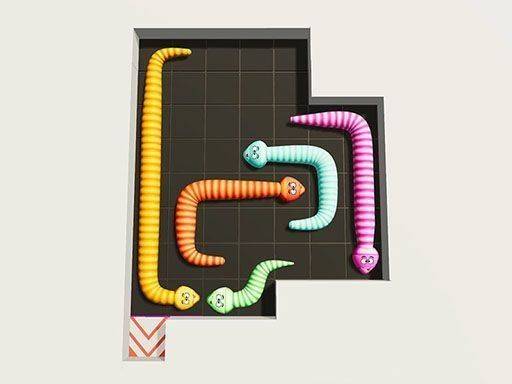
Grid Snake: Spatial Reasoning places snake-like segments on a rectangular board. When you tap or click a segment and choose a direction, it slides in a straight line and stops only at a wall, another piece, or a barrier. Because every segment obeys the same rule, one move can open a path for one piece and close it for another. The puzzle is not about moving a single snake to a target; it is about sequencing moves so no segment becomes trapped before it reaches its goal.
Why Early Levels Feel Different
Early puzzles use small grids and few pieces, which lets you see how a single slide ripples across the board. Later stages add fixed blocks and narrow corridors. Those obstacles change the available routes, so a solution that worked on an open grid often fails once corridors force pieces into specific lanes. Layouts change from level to level, which means you build a general understanding of sliding consequences instead of memorizing one answer.
No Timers, No Score Pressure
There are no timers or score counters. You can undo moves or restart a puzzle without penalty, so experimentation is part of the intended flow. That design supports short sessions as easily as longer ones. Revisiting a solved puzzle is also meaningful because you can look for a shorter or cleaner sequence. The absence of pressure keeps attention on the board rather than on a clock.
Visual Clarity and Audience
The interface uses bright, flat colors with clear contrast between pieces, obstacles, and the background. Animations are smooth but minimal, which keeps attention on the puzzle rather than on visual effects. Controls need only a tap or click and a direction, so no reading or language skill is required. The difficulty range spans from simple enough for young children to complex enough for adults who want a mental workout.
Compatibility
FAQ
Comments
Sign in to leave a note
You must be logged in before posting a review or rating.
No comments yet. Be the first to comment!

Editorial Notes